

Analysing Symbolism in Chinua Achebe’s ‘Things Fall Apart’
Symbolism in ‘Things Fall Apart’ by Chinua Achebe is used to deepen the meaning of the story. This article analyses symbolism in Chinua Achebe’s ‘Things Fall Apart’.
Chinua Achebe’s ‘Things Fall Apart‘ is rich with symbolism that deepens the novel’s exploration of Igbo culture, colonialism, masculinity, and tradition. Achebe used symbolism like yams, locust, fire, and Egwugwu in his 1958 novel, Things Fall Apart, to capture the essence of Igbo traditions and create the needed meaning for the piece. Here’s a breakdown of some key symbols and their analysis:
Symbolism in Chinua Achebe’s ‘Things Fall Apart’
1. The Locusts
Symbolism: The locusts symbolize the arrival of colonialism.
Analysis:
Initially, the locusts are seen as a blessing—they are edible and bring abundance. The villagers are excited and welcome them. However, their massive, consuming presence devours the crops. The coming of the locusts foreshadows the coming of the British colonizers, who also arrived quietly at first and were accepted in some ways before gradually consuming, exploiting, and destabilizing the culture and society. The locusts serve as a natural metaphor for the way colonialism spreads: slowly, then all at once.
An example of this symbol’s expression is seen in the conversion of some people of Umuofia to Christianity. They did so with the belief that the act was harmless but failed to see the damage that what the colonizer preached would do to their culture. One piece of evidence of the damage is seen when Enoch is unmasked an Egwugwu, something unheard of in Umuofia. To further confirm that the locusts represent the white settlers, Obierika, in Chapter 15, said, “The Oracle said that other white men were on their way. They were locusts, it said, and that first man was their harbinger sent to explore the terrain.”
2. The Fire
Symbolism: Fire represents Okonkwo’s passion, anger, and ultimately, his destructive nature.
Analysis:
Okonkwo is often associated with fire, burning, and flame; he is referred to as a “roaring flame.” The only emotion Okonkwo allows himself to feel and display is anger which is often intense. While fire provides warmth and light, it also destroys, just as Okonkwo’s relentless pursuit of masculinity and strength alienates him from his family and community. Just like fire, Okonkwo destroys many things in his life – he kills his son, Ikemefuna, and Ogbuefi Ezendu’s son. To maintain his favoured masculinity aura, Okonkwo suppresses his love for Ikemefuna and Ezimma.
In the end, his fiery temper and refusal to adapt lead to his downfall. The image of fire reflects both his vitality and the ruin he brings upon himself.
3. Yams
Symbolism: Yams symbolize masculinity, wealth, and success in Igbo society.
Analysis:
Yam farming is a man’s work and is often used to measure a man’s status, and ability to provide for his family. Okonkwo’s obsession with cultivating a large yam harvest reflects his desire to embody the Igbo ideal of manhood. His fear of failure marks his understanding of the interpretations of the quality of a man’s yam harvest. Okonkwo never wanted to be like his father who left his family hungry.
However, the pressure to succeed and the association of yams with strength also highlight the toxic expectations of masculinity that define Okonkwo’s life and influence many of his tragic decisions. Yam being a crop cultivated by men and a measure of manliness places men at the center of affairs in Umuofia. This again marks a reason Okonkwo remained aggressive and preoccupied with his yams to maintain his place in the village.
Read also:
Things Fall Apart by Chinua Achebe: Summary, Themes, and Characters
Themes and Characters in Anthills of the Savannah by Chinua Achebe
Chinua Achebe: Biography, List of Books, and Brief Summaries of the works listed
4. Okonkwo’s Gun
Symbolism: The gun symbolizes masculine power, false strength, his fear of weakness, and eventual failure.
Analysis:
Okonkwo’s gun is meant to be a symbol of power, but it ultimately malfunctions during a funeral, accidentally killing a boy. This ironic moment—where his show of strength leads to tragedy—symbolizes the futility of brute force when dealing with deep societal change. It also foreshadows Okonkwo’s later failure to adapt and his tragic end.
The Gun also represents Okonkwo’s attempt to control his environment and assert his dominance, something he values. To Okonkwo, his gun is both a tool of power and a symbol of manhood. As his haunting tool, he displays it with pride, showing his ability to control nature and his family.
Okonkwo’s attachment to his gun is also closely linked to his fear of being perceived as weak. He is deeply ashamed of his father’s weakness and inability to cater for his family’s needs. Okonkwo therefore strives to be strong and successful, his gun a symbol of his focus and aspiration.
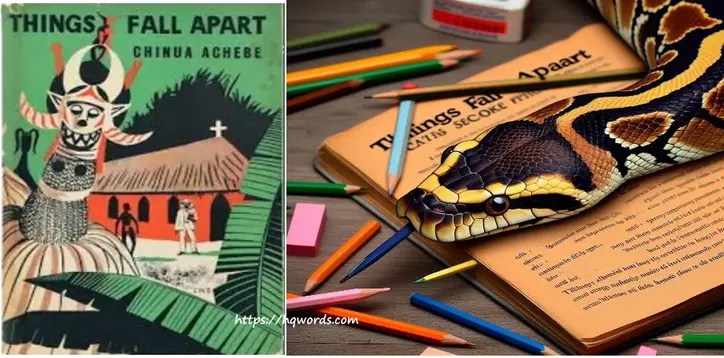
5. The Sacred Python
Symbolism: The sacred python represents religious tradition and the deep spiritual beliefs of the Igbo people.
Analysis:
The python is a revered animal and in Umuofia, it is seen as a representation of the gods and their power. It is connected to the earth goddess, Ani, and other deities. Killing the python is unheard of as it is an act of sacrilege that disrupts the harmony of the village.
When one of the Christian converts, Okoli allegedly kills the python, it is a sign of extreme cultural disruption as he violates the most fundamental rules of the land. It is a violation of their ancestral traditions, a betrayal of the indigenous culture, and disrespect to the gods of the land.
This act also represents the clash between old and new belief systems and the community’s restraint in reacting with violence shows both their reverence for the old ways and their caution in the face of change.
The python’s death is symbolic of the spiritual assault colonialism inflicts upon indigenous belief systems.
6. The Motherland (Mbanta)
Symbolism: Mbanta symbolizes refuge, femininity, and spiritual healing.
Analysis:
Mbanta is Okonkwo’s motherland in Chinua Achebe’s ‘Things Fall Apart’. It represents the Igbo cultural value of the role of mothers and familial connections. The connection to Okonkwo’s motherland is a source of strength and protection.
After being exiled for accidentally killing a clansman, Okonkwo returns to his mother’s village, Mbanta. The contrast between his fatherland and motherland underscores themes of gender and compassion. Whereas Umuofia, his fatherland, emphasizes struggles, war, and strength, Mbanta offers reflection and care—qualities associated with motherhood.
It is also seen as a place of refuge and support. After Okonkwo was exiled from Umuofia, he sought refuge in Mbanta and was welcomed by his mother’s kin, particularly his uncle Uchendu. This is another stark contrast between his motherland and fatherland. In Mbanta, Okonkwo received comfort and acceptance, in Umuofia, he only saw the faces that judge him.
Despite the beauty Mbanta offered Okonkwo, he sees it as a place of weakness, revealing his internal conflict and deep-seated biases. To Okonkwo, Mbanta is emasculating. To him, Umuofia is not just his fatherland but a place that embodies masculinity, where he strives for success and status. His retreat to Mbanta is him acknowledging the feminine power as opposed to his patriarchal worldview.
Mbanta is a symbolic landscape that represents the interplay of tradition, gender roles, and the impact of extraneous forces on the Igbo society presented in ‘Things Fall Apart’.
7. Egwugwu
Symbolism: Egwugwu represents the spirits of the ancestors symbolizing the foundation of the clan, its wisdom, and the authority of the elders in making decisions.
Analysis
Egugwu is a masquerader who impersonates one of the ancestors of the village. In Umuofia, the village where most of the story is set, there are nine Egwugwu, each representing an ancestor from one of the villages that make up Umuofia. The identities of the people that carry the Egwugwu are kept secret. It is an honour to be one of those chosen for this role and in Umuofia, the 9 members of the Egwugwu are respected and feared and their decisions are rarely questioned.
The Egwugwu embody the community’s traditions, cultural identity, and the ability to execute justice. The Egwugwu also serves as a bridge between the living and the dead. For this, they perform the following roles
– Mediate and resolve conflicts based on the laws and traditions of Umuofia.
– Provide ancestral guidance.
– Preserve the community’s identity and traditions.
Okonkwo, the chief character of the story, was a member of the Egwugwu in Umuofia. However, he was replaced when Enoch, a new Christian convert, unmasked an Egwugwu in the name of a new-found religion, violating the long-standing Umuofia tradition. This attack was processed from the lens of what Egwugwu represents – the attack is on a respected person of the community, his clan’s ancestors, and the clan’s foundation and history. This also marks a decline in culture, loss of cultural identity, and the disintegration of traditional values as the community struggles to adapt to the changing world.
Summary of Symbolism Themes in Chinua Achebe’s ‘Things Fall Apart’:
| Symbol | Represents | Broader Theme Explored |
| Locusts | Colonization | Cultural disruption, imperialism |
| Fire | Okonkwo’s passion and destructiveness | Masculinity and downfall |
| Yams | Wealth, status, and masculinity | Gender roles and societal expectations |
| Gun | Illusion of strength and power | Powerlessness, unintended consequences |
| Sacred Python | Religion and spirituality | Clash of belief systems |
| Mbanta (Motherland) | Compassion and refuge | Gender balance, family, and identity |